Tuesday, April 2, 2019

Price comparison when shopping

Supermarkets in Iceland


I wanted to get an idea for myself as to how the well-known Icelandic supermarket chains compare in price here. To do this, I chose four “staple foods” and went to various supermarkets here in Reykjavík and looked at the prices. It's not necessarily representative, just a personal snapshot of my stay in Reykjavík now in March 2019.

I was at the "Bónus Fiskislóð" at the old harbor of the city, ...


... also at the old harbor at the "Krónan Granda", ...


… then at “Tíu-Ellefu”, the “10-11” shop on Austurstræti…


...and at the "Hagkaup" in the Kringlan shopping center.


The next day I was at “Nettó Granda”, also in the commercial area at the old harbor in Reykjavík.


The products I chose for my personal comparison were a liter of fresh milk, a piece of toast (770 g each), a pack of cheese (330 g) and a cup of Skyr (200 g).


In comparison, I can now say that Bónus and Krónan hardly differed in price, Netto was a little more expensive and Hagkaup was a little more expensive - and, unsurprisingly, the "10-11" store was by far the most expensive supermarket.

Of course, you can only compare the shops to a limited extent in terms of their orientation, their location, their offerings and, above all, their opening times. It is obvious that a store that is located in the middle of the city center and is always open day and night has different costs for store rent and staff than a supermarket in an industrial area or in a shopping center. In addition, the range of products on offer, the selection, the layout of the store, etc., differ. Ultimately, it is up to the consumer to think about when and where they want to buy or what alternative they have - or don't have.

The " Bónus Fiskislóð " opens at 10 a.m. or 11 a.m., on Sundays at 12 p.m., and usually closes at 6 p.m. or 6:30 p.m., on Fridays at 7:30 p.m.

The " Krónan Granda " is open daily from 9 a.m. to 8 p.m., Monday to Sunday.

The " Tíu-Ellefu " in Austurstræti, in the middle of downtown Reykjavík, is open 24 hours every day, so it is a little different than the classic supermarkets on the "outskirts" or in the shopping center.

The " Hagkaup " in the Kringlan is (at the moment) open from 10 a.m. to 6 p.m., on Sundays it only opens at 1 p.m., but on Thursdays it is open until 9 p.m.

Like the 10-11 store in the city center, the " Nettó Granda " is also open 24 hours a day.

(Just a note - other stores in the different chains often have different opening times.)

Here is an overview of the prices that I wrote down:


Bonus Kronan 10-11 Hagkaup
Net


1 piece of toast 409 ISK 410 ISK 699 ISK 445 ISK 449 ISK
1 liter of milk 178 ISK 154 ISK 369 ISK 189 ISK 155 ISK
1 pack of cheese 725 ISK 729 ISK 1,119 ISK 879 ISK 789 ISK
1 cup of skyr 175 ISK 178 ISK 309 ISK 209 ISK 189 ISK

1,487 ISK 1,471 ISK 2,496 ISK 1,722 ISK 1,582 ISK


Converted, my “shopping cart” cost around €10.90 at Bónus, around €10.80 at Krónan and around €11.60 at Nettó. At Hagkaup it cost a good €12.60 and at 10-11 it cost a good €18.30.

As a point of comparison - in Germany I pay around €4.20 at my usual supermarket for a roughly comparable shopping basket with milk, cheese, skyr and toast.


[Translated from here.]

Wednesday, March 27, 2019

Bulsu- og byggsalat

Pearl barley salad with vegetarian sausages


I have already told you about the Icelandic meat substitute products based on barley grown in the country, which I came across by chance during my last stay in Iceland. Now the recipe for the pearl barley and barley sausage salad!


Ingredients

200 g barley pearls
1 cucumber
200 g tomatoes
1/2 onion
2 Tbsp pumpkin seeds
1 Tbsp parsley

1 pack of Bulsur

100 ml rapeseed oil
1 Tbsp mustard
1 Tbsp lemon juice
1/2 tsp coarse sea salt
1 pinch of pepper


Preparation

Prepare the barley pearls according to the instructions on the package, cook them and then allow them to cool thoroughly.

Clean and chop the vegetables, wash and chop the parsley.

In a large bowl, mix the cooled pearl barley with the cucumber and tomato pieces, the chopped onions, the pumpkin seeds and the chopped parsley.

Carefully remove the vegetarian sausages from the plastic packaging and fry them in a pan with a little oil until crispy.

Then cut the bulsur into slices and stir in as well.

For the sauce, mix the mustard with the lemon juice, salt and pepper.

Then slowly pour in the rapeseed oil, stirring constantly, until a uniform liquid is formed.

Then pour the sauce over the salad and serve immediately.


As a side dish I also had Rauðrófubuff, a vegetable burger with beetroot.


[Translated from here.]

Tuesday, March 26, 2019

Sausages for vegetarians and vegans

Meat substitute in Icelandic


A typical Icelandic product that has long been replaced by imported products such as rice and pasta, but is now experiencing a renaissance (even in more sophisticated cuisine), is pearl barley, known as "bankabygg" in Icelandic. In contrast to rice and pasta, barley is grown in Iceland itself and is therefore a regional product that does not have to be imported in a laborious or expensive manner.

In connection with pearl barley, I recently came across Icelandic meat substitute products for vegetarians and vegans, namely vegetarian "sausages" and "Grænmetisbuff", i.e. vegetable burgers. Both products are made from barley pearls. Pearl barley has long been traditionally used in the production of sausages in Iceland, usually in addition to meat, not instead of meat. But why not try new things? Because I'm a curious person, I tried both out right away!


The name "Bulsur" is a play on words from "bygg" (= barley) and "pylsur" (= sausage). The "Bulsur" from the Havarí company consist of barley, kidney beans, water, tomato puree, cornmeal, flour, seeds, oil, salt and other spices. In Iceland you buy them frozen in packs of four, for example in Krónan, Nettó or Hagkaup. For my 300 g pack in the Krónan Granda I have just under 900 ISK (the equivalent of around €6.60 / as of March 2019).

The "Bulsur" are packed in a plastic wrapper, you have to remove the packaging from the individual "sausages" before putting them in the pan or on the grill.


The “vegetable burgers” from Móðir Jörð in Vallanes are available in two versions, one with barley and another with beetroot. I chose the beetroot version ("Rauðrófubuff"), a pack (250 g) with 4 citizens cost just under 800 ISK (approx. €5.90). Here, too, the product consists of over 40% barley, plus potatoes and beetroot (23%) as well as herbs and spices. The "breading" consists of pearl barley and sesame seeds, which gives the whole thing a nice, crunchy consistency on the outside.

The “vegetable burgers” are heated in a pan or in the oven.


In terms of taste, I actually found both tasty - for my taste, the "Bulsur" had a consistency that reminded me less of sausages and more of dumplings, soft and almost a bit creamy, but they tasted nice and spicy with the fried surface it's a bit crunchy again. Because of the breading, I found the "Rauðrófubuff" to be very crunchy on the outside and soft on the inside, but not too soft, still a little bit chunky... definitely very tasty!

I prepared both for lunch, the fried burgers and a pearl barley salad with fried bulsur. I'll definitely pass the recipe on to you in the next few days!


[Translated from here.]

Monday, March 11, 2019

Skyr hummus

Skyr hummus


Okay, of course this isn't a classic Icelandic recipe - but I think it's very nice to put a traditional ingredient like skyr in a completely new, different context. And it was really really tasty!


Ingredients

1 can of chickpeas
(drying weight approx. 400 g)
1 clove of garlic
1 Tbsp lemon juice
150 g pure Skyr
1/2 tsp coarse sea salt
1 pinch of black pepper
1/2 tsp cumin

1 tsp olive oil
1 Tbsp pumpkin seeds
1 pinch of salt and pepper


Preparation

Drain the chickpeas well.

Then put the chickpeas in the blender with the garlic, lemon juice, skyr, salt and pepper and cumin and puree well.


Then serve the Skyr hummus in a bowl with a little olive oil, the pumpkin seeds and a pinch of salt and pepper.


Serve with bread - we had grilled flatbrauð with it.


[Translated from here.]

Grillað flatbrauð

Grilled flatbread


Traditionally, Icelandic flatbrauð is made with just flour and water and then baked on a hot stove or cast iron skillet. This is a more "newfangled" recipe with yeast, salt, sugar and a spoonful of olive oil. This Flatbrauð is grilled here or alternatively baked in a grill pan.


Ingredients

500 g wheat flour
1 tsp dry yeast
1 Tbsp sugar
1 Tbsp salt
350 ml warm water
1 Tbsp olive oil


Preparation

In a large bowl, mix the flour with the yeast, sugar and salt.


Add the water and a tablespoon of olive oil...


...knead into a smooth dough...


...and let it rise at room temperature for at least 2 hours.


Then knead the dough again, if necessary adding a little more flour if the dough still sticks while kneading. Divide the dough into 6 to 8 portions.


Then roll out each portion of dough to a somewhat round shape and grill it on the grill (or, as I do here, in a grill pan) until the bread is baked through and has already become nice and dark in places.


The Flatbrauð can be served warm or cold as a side dish, depending on your taste.


[Translated from here.]

Sunday, March 10, 2019

Brúnaðar kartöflur með rjóma

Caramelized potatoes with cream


Caramelized potatoes are, in a sense, THE typical Icelandic side dish and are traditionally served with meat dishes, usually with red cabbage, peas or green beans.


Ingredients for 4 persons

1 Tbsp butter
100 g sugar
100 ml cream
1 kilo of potatoes


Preparation

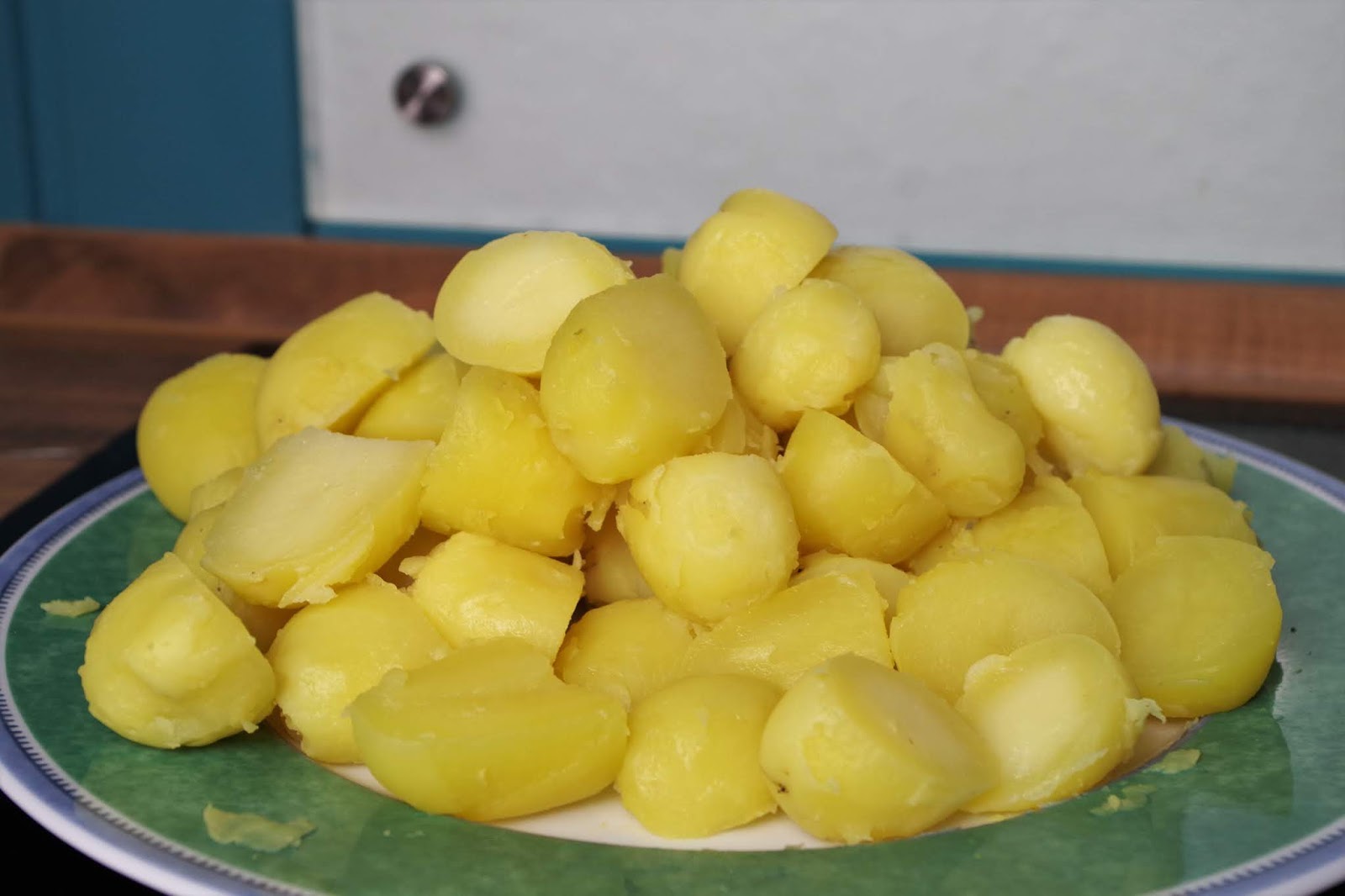
Wash the potatoes, boil them in salted water...


...and peel.


Melt the butter and sugar in a large skillet.


Add the cooked potatoes and stir over high heat until all the potatoes are evenly caramelized.


Pour in the cream and continue to simmer.


Bon appetit!


[Translated from here.]

Eggjamúffur

Egg muffins


The recipe made enough for me for 20 muffins - with salad on the side it was a nice meal for 6 people. Even though my children thought it would be okay as a starter, they would prefer something more “solid” as a main course. Well, next time I'll take it to heart!


Ingredients

10 large eggs
250 ml sour cream
1 red pepper
1 yellow pepper
1 bunch of spring onions
1/2 tsp coarse sea salt
1 pinch of freshly ground pepper
200 g spicy cheese


Preparation

Preheat the oven to 350 °F (180 °C) upper/lower heat.

Place all eggs in a large bowl...


...and whisk with the sour cream.


Clean and chop the peppers and spring onions.


Mix the peppers and spring onions with the egg mixture.


Grate the cheese...


and stir in half of the grated cheese, seasoning with salt and pepper.


Then pour the mixture into a greased muffin tin or one lined with paper cases.

Spread the remaining cheese on the muffins...


...and then bake in the oven at 350 °F (180 °C) for about 25 minutes until the muffins are nice and golden.


Serve immediately after baking - with a fresh salad on the side - a nice complete meal, at least for my taste.


[Translated from here.]