Showing posts sorted by date for query rúgbrauð. Sort by relevance Show all posts

Tuesday, August 5, 2025

Klassískt eggjasalat

Classic egg salad


Classic Icelandic egg salad basically consists of hard-boiled eggs and mayonnaise.

This can be varied depending on taste and the ingredients available. Traditionally, pepper, lemon pepper, salt, garlic, dill, curry, or paprika are often used as spices , along with other ingredients such as onions, red onions, apples, leeks, cucumbers, bacon, grated cheese, sour cream, sweet mustard, and fresh chives or parsley. You can really go wild with this recipe according to your own personal taste!

I chose a version with red onion and fresh parsley, a little spicy and nicely flavorful!


Ingredients for 2 people

3 hard-boiled eggs
2 Tbsp mayonnaise

1/2 red onion
2 Tbsp fresh parsley
1 pinch of pepper
1 pinch of coarse sea salt
1 pinch of paprika powder


Preparation

Peel the hard-boiled eggs and cut them into small cubes.


In a bowl, mix the eggs with the mayonnaise.


Peel and dice the onion.


Wash, pluck and chop the parsley.

Add the parsley to the salad, season with salt, pepper and paprika to taste and mix thoroughly.


Let it sit in the fridge for a while, maybe half an hour, and then serve well chilled.


We ate the egg salad with Icelandic rye bread (rúgbrauð) for dinner.


[Translated from here.]

Thursday, June 19, 2025

What’s special about Icelandic food?

Welcome to my blog!

Iceland - the land of geysers, volcanoes, and vast open landscapes - is also a surprising culinary destination. To make your introduction to this fascinating world a bit more fun, I’ve put together a special treat: a short video featuring a witty troll woman who shares stories about Icelandic cuisine. She talks about ancient traditions, quirky specialties, and modern influences - and you might find yourself chuckling at fermented shark or licorice ice cream.

Check out the video - I think it’s the perfect appetizer for anyone who wants to discover Iceland’s culinary side!

And if you're curious about what makes Icelandic cuisine so special, read on:

What makes Icelandic cuisine unique?

Icelandic cuisine is as unique as the country itself: shaped by the forces of nature, ancient traditions, and surprisingly modern ideas. When you think of Iceland, you might think of geysers, volcanoes, and the Northern Lights - but the island in the North Atlantic also has a lot to offer in terms of cuisine.

Natural. Original. Surprising.

In Iceland, people cook with what nature provides - and they do so with great care. Lambs are raised freely in pristine landscapes, fish is caught fresh from the icy Atlantic, and dairy products like skyr have a centuries-old tradition. At the same time, young chefs are experimenting with seaweed, wild herbs, and vegetables grown using geothermal energy - sustainably, creatively, and with bold flavors.

Between Viking food and street food cult

Icelandic cuisine isn't afraid of anything: fermented shark and smoked sheep's head meet hot dogs wrapped in sheep intestines and creamy licorice ice cream. What may sound unusual to outsiders is, for Icelanders, part of their identity - and often surprisingly delicious.

Simple but sophisticated

Many dishes use just a few ingredients - but ones of exceptional quality. Whether it's rugbrauð (sweet rye bread from the earth), grilled lamb with herb butter, or fish with a squeeze of lemon: Icelandic cuisine thrives on clarity, freshness, and the courage to embrace simplicity.

More than just food

Eating in Iceland is also a social experience: The "Ísbíltúr" (ice cream tour) is as much a part of summer as "Nammidagur" (Sweet Saturday) is of the weekend. Those who explore traditional dishes discover not just new flavors, but a piece of living history.

Conclusion:

Icelandic cuisine is honest, down-to-earth, and full of character. It tells the story of a life in harmony with nature – and how to make the most out of very little. Those who embrace it will be rewarded: with new taste experiences, exciting stories, and a very special perspective on a fascinating country.

And if you want to know more, here are a few highlights:

Monday, June 2, 2025

Íslenskar rúgbrauðstertur

Icelandic rye bread cakes


I love rúgbrauð, that heavy, sweet, moist Icelandic rye bread.

In Iceland, this bread is often baked in hot earth, usually in a tin can that is buried in the ground for 10 to 24 hours (depending on the local temperature). This bread is known, for example, from Heimaey after the 1973 volcanic eruption, from the Mývatn region, or from the geothermal bakery near the "Fontana" swimming pool in Laugarvatn.

In some places there are also communal "ovens" where the inhabitants can bake their rye bread in special devices using the hot steam from geothermal energy.


Since I don't have hot earth or a nice village community oven at my disposal, I usually bake my rúgbrauð in clean, washed milk cartons for about 11 hours at 90°C fan-assisted oven.


The rye bread tastes so delicious - and you can also use the bread for other purposes. For example, old, dry rye bread can be used up wonderfully in classic, sweet rye bread cakes.


If you would like to try a typical Icelandic rye bread cake, you can find various recipes here on the blog:


This recipe comes from an old Icelandic cookbook from 1858. The cake is made with bread, lots of eggs, a generous amount of sugar, grated almonds, and—most luxuriously—juiced fresh oranges. You can also substitute orange juice. My husband thought the cake had a bit of a Christmassy feel.

Rugbrauðskaka

This recipe for a rye bread cake with eggs, brown sugar, cocoa and potato flour, as well as plenty of cream filling and grated chocolate, comes from a collection of Icelandic Christmas recipes from the 1960s.


This was the first rye bread cake I tried for the blog, back in 2015—a delicious cake with ground hazelnuts, sugar, lots of eggs, and a rich cream with whipped cream, mascarpone, grated dark chocolate, and blueberries.

Very tasty — and reminded me of the hazelnut cake with cranberries and cream that my mother often baked for birthdays when I was a child — I almost felt nostalgic about this rye bread cake.

Rúgbrauðsterta með jarðarberjum - rye bread cake with strawberries

And sometimes it's not so easy to follow a particular recipe in Iceland. Last year, I wanted to recreate the recipe from 2015, but then I couldn't find the ingredients at the supermarket. So I had to get creative. I replaced the ground hazelnuts with a mixture of ground almonds and chopped hazelnuts; I used cream cheese instead of ricotta, but adjusted the ratio of cheese to cream; and I used strawberries instead of blueberries.

I was absolutely thrilled with the result—and I found the chopped nuts in the soft dough particularly delicious!


I recently found this recipe for a traditional Icelandic rye bread cake ("the good old rye bread cake") online, in an old article from the magazine Morgunblaðið from December 1967.

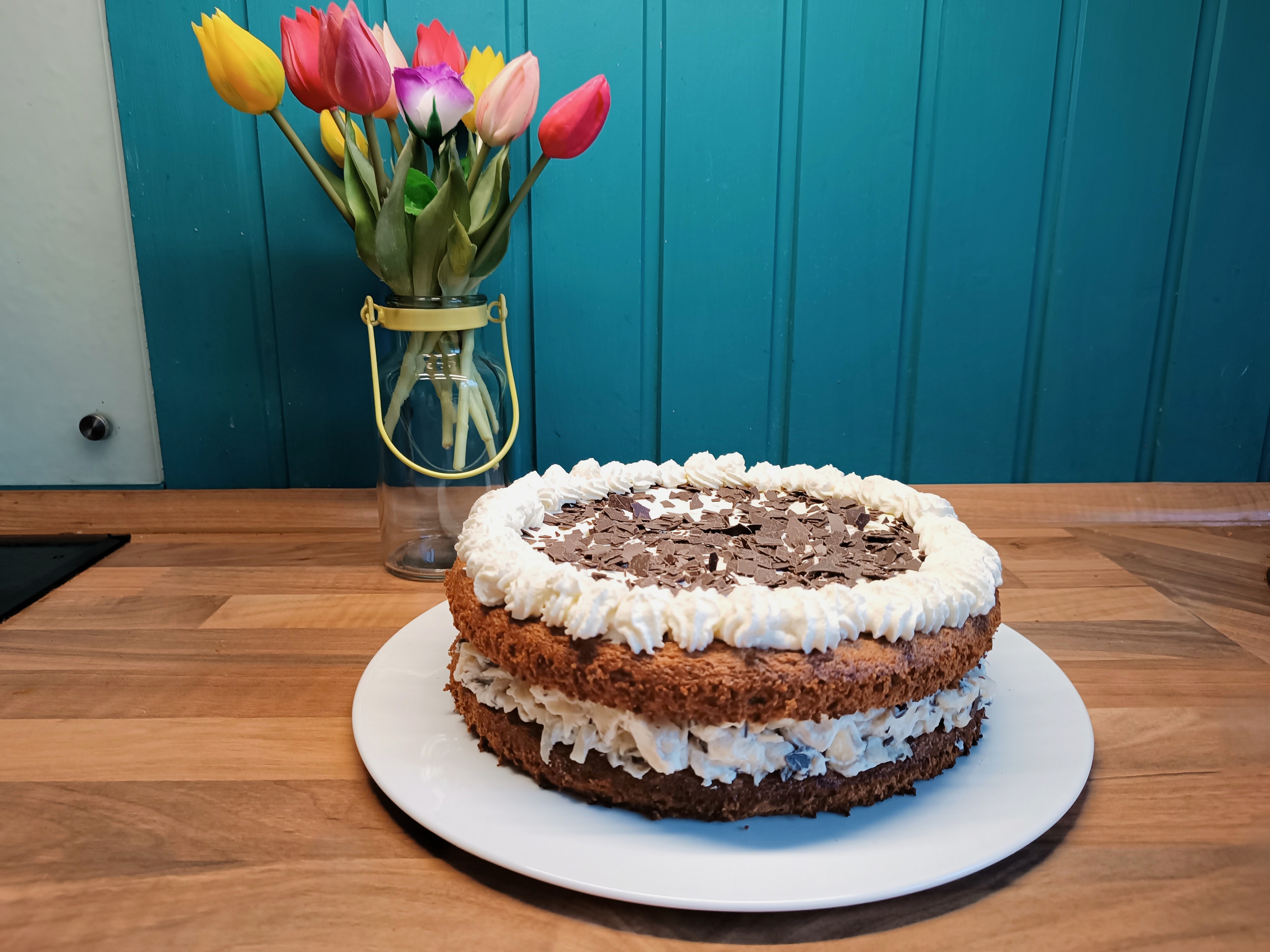
For the cake, apart from the Rúgbrauð, you mainly need eggs, sugar, some flour and a bit of potato flour, and the filling consists of cream, bananas, apples and grated chocolate.


Alternative: Pumpernickel

In Germany, I use pumpernickel for these rye bread recipes. It's not the same, but the result is really good; the taste and consistency are ultimately really good.


[Translated from here.]

Sunday, May 25, 2025

Gamla góða rúg­brauðstertan

Traditional rye bread cake


I love rúgbrauð, that heavy, sweet, moist Icelandic rye bread. It tastes so delicious - and you can also use it for other things, like a rye bread cake.

Here on the blog, I've already tried and presented various typical Icelandic rye bread cakes - today I have another recipe for you. I found this recipe online, in an old article in the magazine Morgunblaðið from December 1967.

For the cake, apart from the Rúgbrauð, you mainly need eggs, sugar, some flour and a bit of potato flour, and the filling consists of cream, bananas, apples and grated chocolate.

Since I didn't want to bake Icelandic rye bread specifically for the cake in Germany, I used pumpernickel for the recipe and I think the result is really good!


Ingredients

4 eggs
200 g sugar
125 g pumpernickel
1 tbsp potato flour
60 g flour
1.5 tsp baking powder

2 bananas
2 apples
1/2 lemon
50 g grated chocolate
200 ml whipping cream

300 ml whipping cream
chocolate to taste


Preparation

Preheat the oven to 400 °F (resp. 200 °C) upper/lower heat.

Separate the eggs.


Mix the egg yolks with the sugar in a large bowl.


Chop the pumpernickel thoroughly...


...and mix with the flour, potato flour and baking powder into the egg-sugar mixture.


Beat the egg whites until stiff and carefully fold in.


Carefully fold the beaten egg whites into the remaining ingredients.


Pour the dough into two springform pans lined with baking paper (approx. 8 inches resp. 20 cm diameter)...


...and bake at 400 °F (200 °C) for about 10 to 15 minutes. Then let cool thoroughly and carefully remove from the springforms.


For the filling, wash, peel, quarter and finely grate the apples.


Cut the bananas into small pieces.


Whip the 200 ml of cream for the filling until stiff and mix with the grated apples, the banana pieces and the grated chocolate.


Place the first layer on a cake plate or similar and spread the filling evenly over it.


Then place the second layer on top, whip the remaining cream until stiff and decorate the cake as desired.


Serve the Rúgbrauðsterta well chilled.


Bon appetit!


Translated from here.]

Saturday, February 22, 2025

Bless bless, Þorri!

Goodbye, Thorri!


The Old Icelandic calendar only knew two seasons, winter and summer. Winter lasted from mid-October to mid-March, summer was from mid-March to mid-October. However, summers in Iceland were always short and often not particularly warm, while winters were long, cold and full of hardship.

Accordingly, back in Iceland, a person's age was measured by the number of winters they had already survived. We have just been practicing this in Icelandic class, where we are currently reading a children's version of the Egils saga, when the great Viking killed his first man at the tender age of 7: "Egill var á sjöunda vetri", Egill was in his 7th winter when he committed his first murder.

The fourth winter month of Þorri

The Old Icelandic winter month of Þorri begins on Friday between January 19th and 26th, with the 13th week of winter. This “drought month” was the month in which all supplies were finally used up and there was still nothing new and fresh to eat.

This month used to celebrate a great pagan sacrificial festival, the Þorrablót, the sacrificial festival in the month of Þorri. Or for the month of Þorri, with which an attempt was made to make this cold winter month a little milder, so that it wasn't too grim. People decorated their houses, similar to Christmas or Easter. There were also special customs. So on bóndadagur, the first day of the month of Þorri, the farmers skipped around the house barefoot in only their shirts and one trouser leg, dragging the other trouser leg behind them and thus marking their farm and their property, and afterwards their wives gave them particularly delicious food such as pickled mutton testicles or singed sheep's head. And freshly baked Flatbrauð.

Flatbrauð in the Viking kitchen in Haitabu (May 2024)

In addition, there were celebrations again on the farms, with all the traditional dishes that had a long shelf life in winter - foods such as black pudding and liver sausage, pork testicles, whale meat or seal fins, which were marinated in acidic whey and thus preserved for a long time. The “guest of honor” at Þorrablót was always the winter month of Þorri itself, which was intended to be merciful with this sacrificial festival.

Vikings in Haitabu (May 2024)

These traditional Icelandic customs surrounding the sacrificial festival of Þorrablót were apparently largely suppressed in the course of Christianization.

The first recorded Þorrablót of modern times only took place in 1873, organized by a group of Icelandic students. From around 1880 onwards, the Icelandic Society for Classical Studies celebrated a festive Þorrablót every year. In the 1950s, local heritage associations also held festive Þorrablóts to mark the occasion. From 1958 onwards, the Naustið restaurant in Reykjavík, on the initiative of one of the owners, Halldór S. Gröndal (1927 - 2009), offered Þorramatur in order to give city residents the opportunity to get to know these traditional dishes.

Today, local associations hold their Þorrablót festivals all over the country. But you can now easily get almost everything you need for a hearty Þorrablót at home with friends or relatives in the supermarket:


You can buy various súrmatur, i.e. meat products marinated in sour whey, in a 2 liter bucket. And if you don't dare buy the 2 liter bucket, you can also buy smaller quantities, for example a Þorrabakki, i.e. a tasting tablet with various traditional Þorramatur dishes.

Typical Þorramatur dishes include lamb smoked over sheep dung (hangikjöt), salt meat (saltkjöt), brawn such as sheep's head brawn (sviðasulta), pickled ram testicles (súrsaðirhrútsprungar), various blood sausage and liver sausage dishes (blóðmör og lifrapylsa),
and rolled meat (lundabaggar), but also fish dishes such as dried fish (harðfiskur) and rotten shark (hákarl).

Traditional side dishes for Þorrablót are often mashed turnips (rófustappe) and mashed potatoes (kartöflumús), as well as the typical Icelandic sweet rye bread (rúgbrauð) and thin flatbread (flatbrauð).

In addition, people used to drink plenty of high-proof alcohol, such as Brennivín.


I found a recipe for a typical Þorrablót dish in an old cookbook, but for various reasons I didn't actually try it myself:

For the pickled ram's testicles in brawn (here on the right on the plate), the testicles of the freshly slaughtered sheep are placed in boiling salted water in autumn and allowed to cook for about an hour. The cooked testicles are then removed from the broth with a ladle. The jelly is then prepared from a little broth with salt and aspic. The cooked testicles are then placed in a large container (e.g. used 2 liter bucket from súrmatur), poured with the jelly and placed something heavy on top for pressing. When the jelly has set, cut the brawn into thick slices and pour plenty of whey over them. The whey is then changed regularly, first after about 2 weeks, then after about 6 to 8 weeks, and in January the pickled hrútsprungar are ready to enjoy. Or for consumption, however you take it.


Honestly, to a taste of a Central European, many of these traditional meat dishes aren't even that tasty. But of course we tried it anyway!


And on February 23, 2025, the next, fifth winter month begins, the month of Góa. This month starts on Sunday in the 18th week of winter, i.e. today between February 18th and 24th. On the first day of this month, Iceland celebrates konudagur, or “Women’s Day”.

By the way, there is a weather rule in Iceland, it is said that if Women's Day was stormy and the weather was bad in the first days of this month, it should be a good summer. Let's see what the weather will be like on Sunday - and what summer 2025 will be like.


[Translated from here.]

Thursday, November 7, 2024

Grænkálspestó

Kale pesto


In other countries, kale is a typical winter vegetable. It is often said that kale should only be harvested after the first frost. Kale doesn't actually need frost to convert starch into sugar; generally low temperatures are enough. Ripe kale contains hardly any starch that could be converted, but continues to produce glucose through photosynthesis. And “generally low temperatures” are not a problem in Iceland, where the low temperatures often exist all summer long.


Here in Iceland, kale grows outdoors and thrives particularly well. The harvest time is usually from July to December and the kale can then be bought fresh in the supermarket. Since there are not that many vegetables here that can grow without geothermal energy, kale is used in a variety of ways in Icelandic cuisine, for example fresh in salads, smoothies or juices, cooked in soups, fried as a side dish or casseroles. There are also kale chips - and they are also very suitable for fresh pesto.

Kale is also good for a healthy diet - like most types of cabbage, it is rich in vitamins, minerals, fiber and protein. It even ranks first among cabbage varieties in terms of its content of vitamins B, E and K, calcium, folic acid and iron. It also contains a number of phytochemicals that regulate cholesterol and blood sugar levels and strengthen the immune system.


Ingredients

100 g fresh kale
3 Tbsp fresh basil
60 g pine nuts
30 g parmesan
1 pinch of garlic powder
1 pinch of fresh pepper
1 pinch of coarse sea salt
80 ml rapeseed oil


Preparation

Wash the kale and basil.

Remove the stem from the kale and pick the basil leaves and cut everything into small pieces.


Place the kale and basil in a tall container, add the pine nuts, parmesan, garlic powder and pepper, pour the rapeseed oil over it and puree everything thoroughly with the blender.


If necessary, add a little more rapeseed oil and mix until the desired consistency is reached.

Finally, season with salt and pepper to taste. Be careful with the salt as the parmesan cheese is already quite salty.


We had the kale pesto as a side dish with the grilled meat and on buttered rye bread (rúgbrauð), both of which were very tasty!


[Translated from here.]