Saturday, December 21, 2024

Rjúpa og sósa

Ptarmigan and sauce


A classic Icelandic Christmas food is ptarmigan (rjúpa). However, the animal population in Iceland is declining drastically, which is why ptarmigan hunting has been increasingly restricted, for example hunting is only allowed on certain days of the year and the number of animals per hunter is also limited. Hunting is only permitted for personal use; selling is prohibited.

However, you can now find ptarmigan from Great Britain frozen in Icelandic supermarkets - either breasts or whole birds. On average, a bird weighs just around 400 g.

Classic side dishes for the ptarmigan here with the sauce are potatoes, peas and cold red cabbage, but fresh salad, for example, also tastes good with it.


Ingredients for 4 servings

Ptarmigan breast (2 pieces per person)
1 tbsp butter
salt and pepper

1 small onion
500 ml cooking cream
100 ml vegetable broth
1/2 mushroom cheese / pepper cheese
2 Tbsp blue cheese
2 Tbsp blackcurrant jelly / rhubarb jam
salt and pepper


Preparation

Season the ptarmigan breasts with salt and pepper...


...and fry in melted butter in a pan for about 1 minute on each side.


Then put it in a fireproof dish, set it aside and then put it in a preheated oven (350 °F resp. 180 °C upper/lower heat) for 8 to 10 minutes just before serving.


To make the sauce, first chop the onion and let it become translucent in the butter in which the ptarmigan breasts were fried.

Add the cream, the vegetable stock and the finely chopped pepper cheese and let the sauce simmer slowly, stirring regularly.


Finally, chop up the blue cheese and add it.


Season the sauce with the jelly or jam and salt and pepper.

Then leave the sauce on the stove at a low temperature for a moment while you serve the rest of the food, and then serve.


[Translated from here.]

Friday, December 20, 2024

Jólastemmning

Christmas spirit


In Icelandic there is the expression "Ég er mikið jólabarn! " - "I am a total Christmas child!"

This shows that you are still looking forward to Christmas like a child, to the Advent season, all the beautiful lights, the Christmas decorations, the good food, just the time of year when it is dark outside and the smells of Christmas come through All rooms can be moved and you can make yourself really comfortable at home with your loved ones. Doesn't that sound beautiful...?!?

Normally I'm always the "total Christmas child". Only this year - I think I'm broken. Somehow I don't feel like Christmas at all... I have to do something.

I once started distributing Christmas decorations in our Iceland house. When I turn on the electric candles in the wooden stand above the stove and look outside and there's some snow, it feels a bit like Christmas, doesn't it?

Then I just have to remember to take the candle holder down and put it somewhere else before we fire up the oven...


I also freed the glowing Christmas gnome from his drawer and gave him a new battery. Now he can spread his cozy light again, from sunset (currently around 3:30 p.m. for us) to sunrise (currently around 11:15 a.m.).


And I also hung the Christmas curtain on the kitchen window, red checked and with big snowflakes and little Christmas elves. Plus a Christmas tea that smells wonderfully of cinnamon...


In the hallway I wrapped a red, glittering garland around the frame of the mirror...


...and our Christmas tree is up and ready for use. My husband made the tree himself, a "tree" made of wooden blocks with green-painted "branches" and a beautiful, colorful string of lights. By the way, with this tree we are following the Icelandic tradition of homemade, green-painted Christmas trees.


I'm also on vacation now and today I finally baked my first Christmas cookies. Maybe now I'll finally get in the mood when things get a little quieter here...


[Translated from here.]

Thursday, December 19, 2024

Jólatré á Íslandi

Christmas trees in Iceland


Have you ever thought about how long the tradition of putting up decorated Christmas trees has existed in Iceland?

Christmas trees actually haven't been around that long - there are first reports from the beginning of the 16th century that talk about Christmas trees being put up at Christmas time.

Christmas trees became somewhat widespread in Germany in the second half of the 16th century, after the Reformation, when the first Protestants found it inappropriate to set up a nativity scene following Catholic custom. Over time, candles were attached to the branches of the Christmas trees and decorated with apples, nuts and icing.

The custom of putting up evergreen fir trees at Christmas only spread in Europe from the second half of the 18th century. The first Christmas trees came to the Nordic countries in the 19th century.

The first Christmas trees appeared in Iceland in the mid-19th century - mainly among wealthy Danish merchants and officials who knew this custom from their time in Denmark.

Since no wild spruce trees grew in Iceland, the first Christmas trees in Iceland were homemade , made of poles and sticks and sometimes painted green or red. They were often decorated with candles that were attached to the "tree" with wax, or the trees were decorated with heather, for example.

The oldest of these Christmas trees still standing in Iceland dates back to 1873.

At that time, the newly married Danish woman Kamilla Briem spent her first Christmas in Iceland in the Hruni rectory in Hrunamannahreppur, near Flúðir, and Jón Jónsson , the farmer from the Þverspyrna farm about 2 km away, built a Christmas tree for the young pastor's wife. Kamilla's daughter Elín Steindórsdóttir (1881 - 1965) later inherited the Christmas tree. She lived in Oddgeirshólar, a farm about 10 km east of Selfoss. Elín donated the tree to the Árnessýsla District Local History Museum in 1955 . Today the Christmas tree is usually displayed in the museum in Eyrarbakki.

Source: mbl.is / Kristín Heiða

Here in the photo from an article from Morgunblaðið from December 15th, 2024 about a Christmas exhibition from the National Museum in Reykjavík you can see the original Christmas tree from 1873 on the left and a replica on the right, decorated with heather and colorful candles on the ends of the poles, like the tree before Probably looked like 150 years ago.

On the occasion of the 150th anniversary of the Hruni Church, the tree was put up and decorated at the Christmas service in Hrunakirkja. This photo, which I found on the Byggðasafn Árnesinga homepage from 2015, shows Ólöf Elísabet Árnadóttir (1920 - 2017), the granddaughter of Kamilla Briem, with the tree at the Christmas mass in the church.

Source: byggdasafn.is

Around the middle of the 20th century, families in Iceland had their first real Christmas trees. In the beginning it was expensive, imported spruce that many people couldn't afford. Around 1970, the first Icelandic spruces came onto the market as Christmas trees.

Today, most Icelanders probably prefer to have a real Christmas tree in their house, which they then decorate, often colorfully and with homemade ornaments that they accumulate over the years. But it's also not uncommon to get an artificial Christmas tree - probably an obvious decision, especially in a tree-poor country like Iceland, especially since you can then put the tree up again every year.

Artificial Christmas trees in the garden center in Selfoss

But for reasons of sustainability, among other things, homemade Christmas trees are becoming more popular again.

In a way, we are right on trend with our beautiful wooden tree that my husband gave me last year!


Oslóartré - The Oslo Tree

One of the most famous Christmas trees in Iceland is the so-called Oslo tree.

Every year since 1951 , the Norwegian capital Oslo has given the Icelandic capital Reykjavík a large Christmas tree as a sign of the strong friendship and solidarity between the two nations. The tree is placed on the Austurvöllur and lit for the first time by the mayor in a solemn ceremony on the 1st of Advent.

For many years the tree came from Norway and was brought to Iceland by ship, until at the beginning of 2014 Oslo decided to stop giving away Christmas trees for various reasons - but this decision was not particularly well received by the people of Reykjavík.


Eventually it was mutually decided to continue the tradition. The Oslo tree now comes from Heiðmörk, a Norwegian tree plantation near Reykjavík. Tall, beautiful Christmas trees now grow here too, and the transport of the 10 to 12 meter high tree from Norway is saved, also for climate protection reasons.


Definitely a very beautiful, large Christmas tree with a special story!


[Translated from here.]

Monday, December 16, 2024

Heitt súkkulaði

Hot chocolate


This year my husband gave me an Advent calendar with Icelandic chocolate bars, one bar of chocolate every day. By the way, quite a few of them are made with licorice chocolate - typically Icelandic!

In the evening I made hot chocolate with milk from a large bar of my beloved Þristur licorice chocolate.

I think there's nothing like hot chocolate with a light licorice flavor when I want to make myself comfortable in the winter evenings and relax and wind down after a stupid day.


Ingredients for 1 cup

250 ml milk
60g chocolate


Preparation

Bring the milk slowly to the boil in a saucepan.


Cut the chocolate into small pieces.


Add the chocolate to the hot milk and let it melt, stirring constantly, until you have a nice, uniform liquid.


Then serve straight away, decorate to taste with whipped cream and, if necessary, a little cinnamon, coffee spice, licorice sprinkles or similar.

Well then - have a nice evening!


[Translated from here.]

Friday, December 13, 2024

Christmas knitting 2024

New clothing to protect against the Christmas cat


The large, dangerous Christmas cat, Jólakötturinn, is known for its fondness of eating people, especially naughty children and lazy people.

The only thing that can save you from ending up as a bone in that cat's stomach is to wear new clothes for Christmas.


So I do what I can to save loved ones from this terrible fate.

I started with these two Axlarslár, i.e. ponchos or shoulder warmers, in September. Nice and warm and cozy when you get tired and shiver in the evening. And this Léttlopi wool is somehow my favorite color at the moment, this blue-green, color no. 9423 (in Icelandic "Blágrænn yfirlitaður", in English "Lagoon Heather").


Then came this hooded sweater - actually my first Lopapeysa made from the thick Alafoss wool. So far I have mainly knitted the thinner Léttlopi wool and also the thin Plötulopi wool two or three times. So this was a first for me - with the thick wool it definitely protects well from the cat and the cold weather!


Then came a Jólaslá - a shoulder warmer in the classic Christmas colors of red and dark green (this time again from Léttlopi).


And the last project was this Lopapeysa here, also from Léttlopi - I "abused" my husband as a tailor's dummy, the sweater doesn't fit perfectly on him, but it wasn't even intended for him!


So, let's see if I can manage to complete another project before Christmas, more new clothes for dear people to protect against the Christmas cat - on the one hand I still have 11 days, but on the other hand I have a lot less time for knitting than I do would like... Well, let's see!


[Translated from here.]

Wednesday, December 4, 2024

Alþingiskosningar 2024

Iceland has voted


Early parliamentary elections took place in Iceland on Saturday, November 30, 2024.

The year 2024 was a politically eventful year in Iceland, with the resignation of the long-time prime minister, the new election of the president, the early end of the previous government coalition and the subsequent new elections.

The previous government coalition around left-green Prime Minister Katrín Jakobsdóttir had governed Iceland since November 2017 after early elections.

The government elected in 2016 fell apart after less than a year because of an affair involving the father of then Prime Minister Bjarni Benediktsson. There were early elections in autumn 2017. In this election, the Left-Greens became the second strongest force with just under 17%. Since the strongest force, the Independence Party, with a good 25%, could not find a coalition partner who wanted to work with it under the leadership of the Independence Party, Katrín Jakobsdóttir was commissioned by the then Icelandic President Guðni Th. Jóhannesson to form a government. For 7 years she led a coalition of the Left-Green Party, the Independence Party and the Progress Party (almost 11%).

In the next election in September 2021, the Left-Greens only got just under 13% and became the third strongest force, behind the Independence Party with just under 25% and the Progress Party with a good 17%. However, the three parties agreed that Katrín should continue to lead the coalition as prime minister.

In order to run as a candidate in the 2024 presidential election, Katrín Jakobsdóttir resigned from all her positions in April 2024. However, in the election on June 1, Katrín was defeated as runner-up by Halla Tómasdóttir.

Katrín Jakobsottir and Guðni Jóhannesson
in front of Parliament (June 17, 2022)

After Katrín Jakobsdóttir's resignation, Bjarni Benediktsson of the Independence Party became prime minister again on April 10, 2024, taking over the leadership of the coalition. However, the Left-Greens were increasingly less willing to support Bjarni's policies, particularly on migration issues. After the left-green Social Minister Guðmundur Ingi Guðbrandsson successfully advocated for a seriously ill Palestinian boy who was to be deported from the children's hospice, Bjarni Benediktsson asked President Halla Tómasdóttir to dismiss the government and dissolve parliament early. The interim government only consisted of the Independence Party and the Progress Party; the Left-Greens left the government.

The early elections to the Icelandic parliament Alþingi took place on November 30, 2024.
Alþingishús

The polling stations closed at 9 p.m. on Saturday evening, and the preliminary official final result was available on Sunday afternoon.
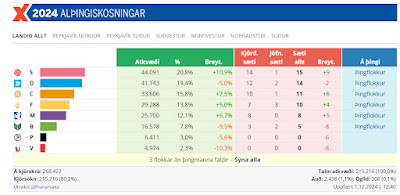
Source: mbl.is

In the future, only six parties will be represented in the parliament in Reykjavík instead of the current eight. In addition to the previous ruling party, the Left-Green Party, the Pirate Party also failed to pass the 5% hurdle.

A continuation of the previous government coalition, which has been led by the Left-Green Prime Minister Katrín Jakobsdóttir since 2017 and by her successor Bjarni Benediktsson since April 2024, is ruled out.

The three previous government parties together lost almost 25% in the early elections.

"Valkyrjurnar eru komnar til að sjá og sigra" -
"The Valkyries have come to see and to conquer"

Since Sunday, President Halla Tómasdóttir has welcomed the party leaders of the parties elected to parliament to her official residence, Bessastaðir, for talks. As it became known today, the three party leaders Kristrún Frostadóttir from the Social Democrats, Þorgerður Gunnardóttir from the Reform Party and Inga Sæland from the People's Party want to start coalition talks from tomorrow (December 4th).

Kristrún and Þorgerður told journalists this afternoon after a meeting in Alþingi that they were aware of the problems at hand, but they believed they had a good basis from which to put together a viable, effective government. Inga was also very optimistic that the meeting went well. "The Valkyries have come to see and win," Inga explained.

Bessastaðir


Which parties have now been elected to parliament?

There are currently eight political parties that have been important at the national level in recent years. Incidentally, the parties in Iceland all have a "list letter" (listabókstafur), i.e. a letter that appears on the ballot paper (next to the name of the party) as a symbol of this political movement in the election. These letters are also indicated in the surveys and election results.


(S) - Samfylkingin - The Social Democratic Party of Iceland

Samfylkingin, the Icelandic Social Democrats, became the strongest party in the November 2024 election with just under 21%.

The party emerged in 2000 from the merger of four left-wing parties, including the Women's List, to act as a counterweight to the Independence Party.

The party positions itself to the left of center and advocates social democratic values, social responsibility and women's rights.

In the 2016 elections, the Social Democrats only got just under 6% of the vote, in 2017 they got around 12% again and fell back to just under 10% in 2021.

The party leader since 2022 has been Kristrún Frostadóttir. The economist, born in 1988, worked as an analyst and chief economist at various banks at home and abroad, but resigned and has been a member of parliament for the Social Democrats in the Reykjavík-South constituency since 2021. She is married and has two children (born 2019 and 2023).


(D) - Sjálfstæðisflokkurinn - the Independence Party

With 19.4%, the Independence Party became the second strongest party in the 2024 parliamentary election.

The Independence Party was founded in 1929. It is the party with the largest number of members in Iceland.

The party represents economically liberal goals and right-wing conservative policies.

From 1944 to 2009, the Independence Party was the strongest party in Alþingi in elections, even though it was not always involved in government and never had an absolute majority. In the 2013, 2016, 2017 and 2021 elections, the Independence Party was again the strongest party with 25 to 30% of the vote.

Bjarni Benediktsson (born 1970) has been the party leader since 2009. The qualified lawyer comes from an influential family, both politically and economically. Bjarni is also sometimes called "Teflon-Bjarni" because of the many political scandals he has sat out without losing his position as one of Iceland's most powerful politicians. Most recently, during his time as finance minister, there were allegations that when the state's shareholding in Íslandsbanki was sold, people who were favored, including Bjarni's father Benedikt Sveinsson, were able to purchase shares in the bank at a price below market value. Bjarni assumed political responsibility and resigned as finance minister - only to take over as foreign minister a few days later. In surveys, Bjarni Benediktsson has repeatedly been named as Iceland's most unpopular politician.

In the November 2024 election, independence received only the second-most votes with 19.4% - the worst result in the party's history to date. However, compared to the last election, the party has only lost 5%, significantly less than the other two coalition parties, which each lost around 10%.


(C) - Viðreisn - The Reform Party

In the November 2024 election, Viðreisn became the third largest party with 15.8%.

The party was founded in 2016, including by numerous former Independence Party members.

The party is committed to social justice, liberal values ​​and responsible use of natural resources, and is also explicitly EU-friendly. and repeatedly speaks out in favor of direct democracy.

In the 2016 parliamentary election, Viðreisn received 10.5% of the vote straight away, and in the 2017 and 2021 elections he received just under 7% and a good 8%, respectively.

Viðreisn's party leader has been Þórgerður Gunnarsdóttir since 2017. The lawyer, born in 1965, was a parliamentarian for the Independence Party in Alþingi from 1999 to 2013, and was also Minister of Education and deputy chairwoman of the party. Unlike the Independence Party, Þórgerður spoke out in favor of Iceland's long-term EU accession. Since 2016 she has been sitting in parliament again for Viðreisn.


(F) - Flokkur fólksins - The People's Party

The People's Party became the fourth strongest party with 13.8% in the November 2024 election.

The People's Party was founded in 2016. The party repeatedly represents populist positions and declares that it wants to fight for the rights of Icelanders who suffered from injustice, discrimination, lawlessness and poverty, especially for the rights of the disabled. The party repeatedly positions itself for the rights of the local population, for conservative social policy and for a strong state.

The party's founder and party leader is Inga Sæland, a visually impaired lawyer (born 1959). Her personal experiences with her disability and the associated difficulties and discrimination in everyday life were the reason she founded the party. She has now distanced herself from previous xenophobic statements and sometimes criticizes the treatment of refugees in Iceland as “cruel”.

When the People's Party ran for parliamentary elections for the first time in 2016, it only received 3.5% of the vote. At the next election in 2017 the party was at just under 7% and in 2021 at just under 9%.


(M) - Miðflokkurinn - The Center Party

The Center Party came in fifth place with 12.1% of the vote.

The party was formed in 2017 as a split from the Progress Party. The party wants to focus economic development on agriculture and tourism, a reorganization of financial and banking policy and is vehemently against joining the EU.

The Center Party's founder and leader is Sigmundur Davið Gunnlaugsson. He was born in 1975 and studied business administration in Iceland, then went to universities in Moscow and Oxford, but without graduating there. He worked for the state broadcaster and, after the banking crisis in Iceland, he organized a petition on social media for the rights of Icelanders in Great Britain. He then ran for leader of the Progress Party in 2009, joining the party two weeks before his candidacy. He has sat in parliament for the Progress Party since 2009 and was Prime Minister of Iceland from 2013 to 2016. He resigned in 2016 in the Panama Papers scandal because of his and his wife's holdings in a shell company in the British Virgin Islands. In September 2017 he left the Progress Party and founded the Center Party in time for the October 2017 elections.

Sigmundur hit the headlines again in 2018 as part of the so-called Klaustur affair: Sigmundur and several parliamentarians from the Center Party as well as two MPs from the Progress Party were noticed in the Klaustur bar, opposite the parliament, by making very sexist and anti-disabled statements. An Icelandic woman who happened to be present overheard the loud conversation, then recorded it on her cell phone and played the recording to the media. As a result of the scandal, the Progressive Party parliamentarians were expelled from their party and then joined the Center Party. The men involved later apologized for their comments, saying they were "very drunk."

The Center Party received 10.9% out of the box in the 2017 parliamentary election and came in fourth place. In the 2021 election, the party only got 5.4%.


(B) - Framsóknarflokkurinn - The Progressive Party


The sixth and last party to pass the 5% threshold in the November 2024 election is the Progress Party with 7.8%.

The Progress Party was formed in 1916 through the merger of the Farmers' Party (Bændaflokkur) and the Independent Farmers (Óháðir bændur).

The party represents the interests of farmers and fishermen and is very critical of the EU. Individual members also attracted attention through statements about Iceland's possible withdrawal from NATO.

In 2005, the Progress Party became the first Icelandic party to introduce gender quotas for both sexes.

At the Congress of the Progress Party in 2015, a draft resolution was presented by the party in which global warming was described as "exciting": Climate change can ultimately lead to a variety of new opportunities for Icelandic agriculture and thus a strengthening of agriculture. However, these expectations have not yet been fulfilled...


[Translated from here.]

Tuesday, December 3, 2024

Jólakötturinn

The Icelandic Christmas Cat


An integral part of the Icelandic Christmas season is the Christmas cat ("jólakötturinn").

The Christmas cat is, so we hear, the house cat of the troll couple Grýla and Leppalúði, the parents of the 13 Icelandic Christmas companions, the jólasveinar.

All year round this cat lives with Grýla,
Leppalúði and her 13 troll sons near the mosquito lake Mývatn in the lava mountains of Dimmuborgir. But at Christmas time she comes down to the people.

The Christmas Cat is a huge, black monster with fiery, plate-sized eyes.


In the dark time before Christmas, the Christmas cat lay in wait for lonely hikers in snowfields and then pounces on them to eat their victims themselves or drag them off to Grýla in the mountains, who she throws into her human meat stew. By the way, Grýla prefers to eat naughty children!

The only thing that can protect people from this terrible Christmas cat is to wear a new article of clothing at Christmas. So a very good reason to work diligently on the wool and knit new clothes after the sheep are driven in autumn.


Since 2018, a figure of the Christmas cat has stood on Lækjartorg in Reykjavík. The cat is around 5 meters high, around 6 meters long and is illuminated with around 6,500 LED lights.


Every year in mid-November, the Christmas Cat lighting is ceremoniously switched on for the first time. The mayor of Reykjavík gives a speech, a brass band plays Christmas music and Grýla and Leppalúði, Santa's parents, mingle and celebrate. This year this pre-Christmas event took place on November 16th.

Have you actually taken a close look at the Christmas cat on Lækjartorg?


If you get close enough, very carefully, without being eaten, you will see in the Christmas cat's stomach all the bones of the people it has already eaten...


I love these lovely little details that give the Icelandic Christmas season its very special charm!


[Translated from here.]